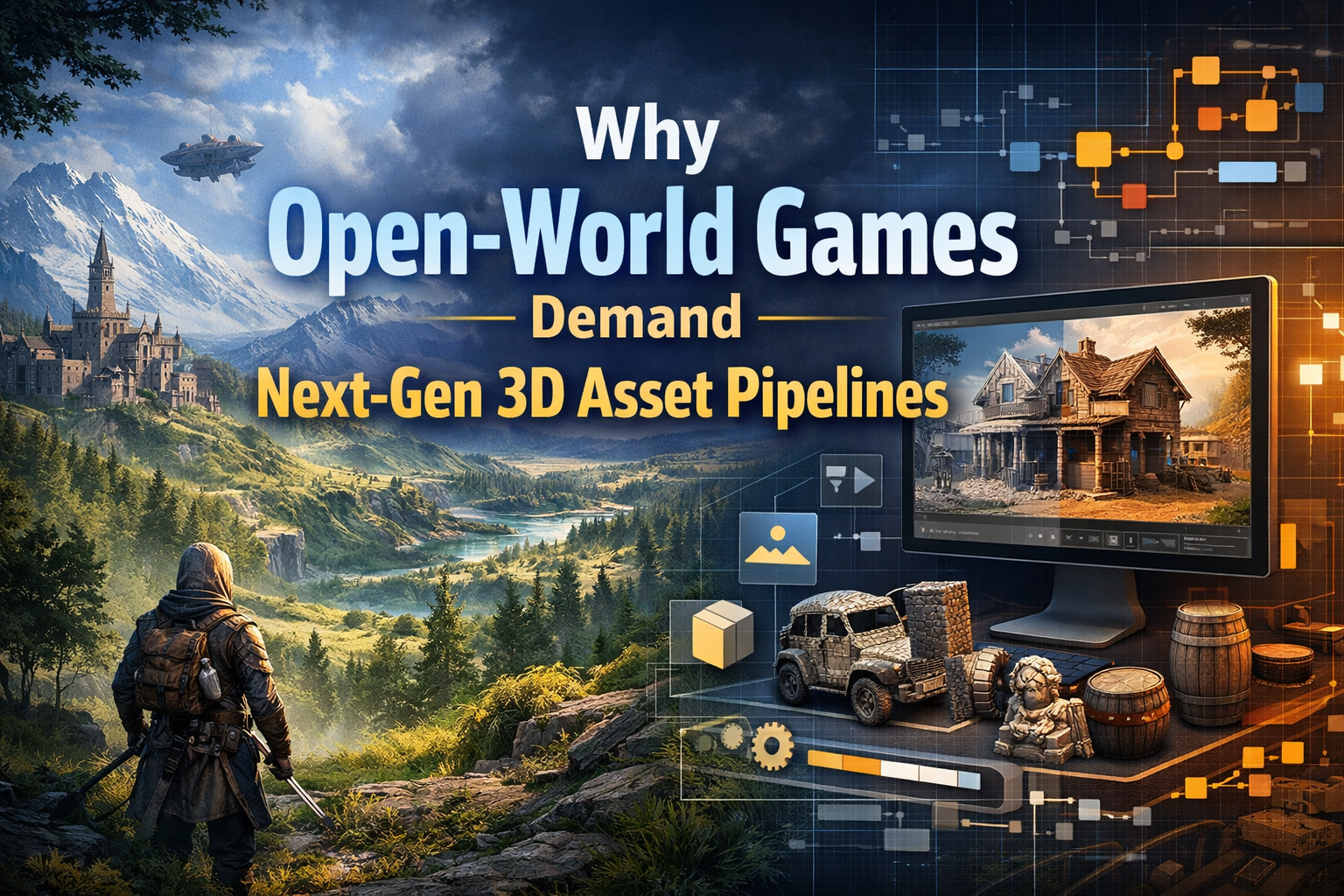
Modern open-world games are not just huge, but they are growing more and more detailed into today’s digital sandboxes. Scaling in size and fidelity presents an existential crisis to the traditional game development methodologies, especially the creation and management of open-world game 3D assets. The vast economies of unique geometry, textures, and the required environmental clutter to create a living world would need a definitive shift in workflows-as with all great leaps forward-in the case of next-gen 3D pipelines.
The scale of an open world is the first, most obvious hurdle. Unlike linear games that are often asset-limited and naturally clear prove geometry, open worlds require hundreds of thousands of mixed open-world game 3D assets that must be immediately rendered. The task of manually modeling, UV unwrapping, and texturing almost a million entities can be exceedingly time-consuming and expensive. A traditional game asset workflow will simply bottleneck production and, therefore, prevent developers from doing what players expect in scale and density.
The Pillars of Next-Gen 3D Pipelines
Following this, next-gen 3D pipelines will be based on three main technologies: procedural generation, real-time rendering systems, and AI-assisted creation.
Procedural Content Generation (PCG) is critical to the process as it is a technique that allows developers to establish rules and parameters to build large, unique environments, such as mountains, forests, city layouts, and all the objects dispersed throughout the environment, without human artists needing to hand place every item. This is critical for constructing the base landscape and efficiently distributing secondary open-world game 3D assets, which greatly and significantly reduces the overall game asset workflow.
Overlapping with PCG is the real-time rendering technology revolutionizing the use of 3D modeling for open-world games. The typical example is Unreal Engine’s Nanite and Lumen systems. Nanite tackles the ‘detail vs. performance’ question directly, allowing for the use of high-fidelity, cinema-quality source geometry (micropolygons) in-engine. This approach essentially removes the need for the manual process of LOD (Level of Detail) from the old game asset workflow, an effort in which artists would make multiple versions of a model at different distances. This feature provides significant acceleration to the asset pipeline.
Evolving the Game Asset Workflow
The addition of generative AI-assisted tools is the last, disruptive experiment of next-gen 3D pipelines. AI capabilities are extending beyond simple concept art to actually assisting with 3D modeling for open-world games. Tools can now handle the more difficult, sometimes most tedious and repetitive human tasks, such as retopology (which is optimizing mesh topology), creating a base geometry from simple text prompts, or making high-quality PBR (Physically Based Rendering) texture maps out of one image. It isn’t replacing the artist, but changing the game asset workflow from purely crafting by hand to a system of creative direction, rapid iteration, and refinement.
The end goal of this evolution of next-gen plug-ins in the 3D asset pipeline is a seamless, high-performance experience throughout a massive world. Every single prop, character, and structure, which are all open-world game 3D assets, should follow strict optimization protocols (consistent texel density, draw calls efficiency, and minimized memory load). In addition, each unique 3D asset should look visually consistent.
Conclusion
The antiquated-style of making low-polygon models and compensating with normal maps isn’t good enough for the fidelity of today. The game has changed, and 3D modeling for open-world games is now about building super high-detail source assets and allowing the engine’s next-gen systems (for example, Nanite) to manage and efficiently render that complexity. This allows the focus of the artist to completely shift from technical performance to artistic quality alone – which is important in achieving the level of visual spectacle that the world expects from any true open-world game 3D assets experience. Future open-world development is one where the architect is composing at scale and cinematic detail in which, more or less, the escape velocity of project-manpower will not overcome the expectations of artistry, but rather bring this truly next-gen 3D pipeline to the future of open-world development in a more automated and smarter way.
Frequently Asked Questions (FAQs)
Q: What is the biggest challenge in creating 3D Modeling for Open-World Games?
A: The primary challenge is balancing the massive scale required for an open world with the demand for high visual fidelity and consistent in-game performance.12 Traditional methods struggle with the sheer volume of assets and the manual optimization required.
Q: How do Next-Gen 3D Pipelines address the “volume” problem?
A: They use technologies like Procedural Content Generation (PCG) to automatically generate vast amounts of unique environmental assets, and real-time geometry streaming (like Nanite) to efficiently render extremely complex Open-World Game 3D Assets without manual LOD creation.
Q: What is the role of AI in the game asset workflow?
A: AI tools accelerate the game asset workflow by automating time-consuming technical steps such as retopology, UV mapping, texture generation, and even initial model generation from concepts, allowing artists to focus on creative refinement.
Q: What is Nanite, and why is it important for 3D modeling for open-world games?
A: Nanite is a virtualized geometry system that allows developers to import and render film-quality source meshes with millions of polygons directly into a game engine.14 It automatically handles optimization and streaming, making high-detail open-world game 3D assets viable at scale.
Q: Does adopting next-gen 3D pipelines mean artists are no longer needed?
A: Absolutely not. Next-gen 3D pipelines elevate the artist’s role by removing repetitive, technical burdens. Artists become creative directors and quality control specialists, defining the style and refining the high-fidelity source models that the pipelines then manage and deploy efficiently.