How Polycount Works
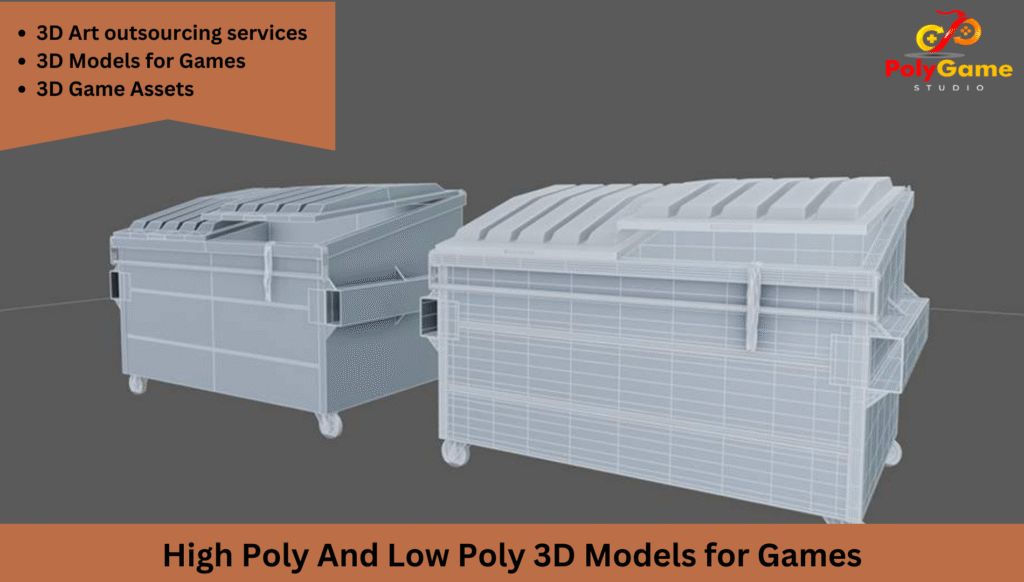
As the world of 3D modeling continues to evolve, two types of 3D Models for Games have emerged as popular options for artists and designers: high-poly and low-poly. Both have advantages and disadvantages, but it is important to understand their differences to achieve the desired results. Low-poly modeling refers to creating 3D Models for Games with a small number of polygons or vertices. This approach suits mobile gaming, virtual reality, and augmented reality environments where performance is important. High-poly models have over 1 million polygons, making them difficult to render and taking up a lot of storage space. Knowing how to create low-poly 3D game assets is important to achieve optimal performance in games
What is a Polygon in a Mesh? High Poly Modeling and Geometry
A polygon is a flat shape with three or more sides that is used to create a mesh. Polygon count refers to the number of polygons used to create 3D Game Assets. Low-poly meshes have fewer polygons, providing better performance in real-time applications and requiring less memory. However, they may need more smoothness and precision.
On the other hand, high-poly models can also have a higher poly count, resulting in greater smoothness and precision. Such high-poly models can also produce more intricate detail and surface textures, but they require more memory and processing power. High-poly objects are often used in pre-rendered animations and films, where realism and detail are mostly static and in the foreground. It may be more effort and time-consuming, but 3D art outsourcing services can help in getting the stunning result.
How to Tell the Difference Between High-poly and Low-poly Models
Identifying high-poly models:
- Close-up shot models tend to take longer to render and require more processing power.
Identifying low-poly models:
- 3D Models for Games have less detail and tend to be more blocky and angular, making them suitable for simpler animations and games.
- Such graphics are generally easier to edit because they do not require as much processing power and can be rendered faster.
Advantages of High-Poly and Low-Poly Modeling
Low-poly and high-poly modeling have different advantages. High-poly modeling also uses dense geometry, which allows for added detail and accuracy as well as visual richness when zoomed in. This is ideal for creating images that require a high level of detail, such as Examples: game characters, objects, environments, and CGI.
Low-poly modeling, on the other hand, aims to optimize the polygon budget, which is beneficial for mobile games and VR. Low-poly models offer an optimized design that reduces rendering time and provides a smooth flow, making retopology easier and importing and exporting models between different programs. Additionally, low-poly models are ideal for creating cross-sectional views that convey technical information, making them a valuable tool for architects and engineers.
Overall, the choice between high-poly and low-poly modeling depends on the intended use and preferences of the triangle player, as well as the skill and preferences of the modeler.
Conclusion
Low poly mesh and high poly 3D Models for Games are two techniques used to create models in the digital world. Low-polygon meshes are created by the author manually reducing the number of polygons in the model, while high-polygon objects are created with a large number of polygons, giving them a more photorealistic appearance.
Both techniques have advantages and disadvantages. Low-poly props require less processing power and can provide faster interactivity, but often lack detail. High-poly elements, on the other hand, can zoom in on the model to show details, creating a more immersive experience. Users can rotate and flip both types of models to provide a realistic feel.
As technology becomes more powerful, the need for photorealism increases. The choice between low-poly and high-poly modeling depends on the precision and visual skills of the software artist currently working, and the calculations required for the project. Ultimately, the level of detail and interactivity you want in your model will determine which technique you use.